Teacher Sign in Apple Embroidery Review
First Impressions: Charm, Clarity, and Classroom Warmth
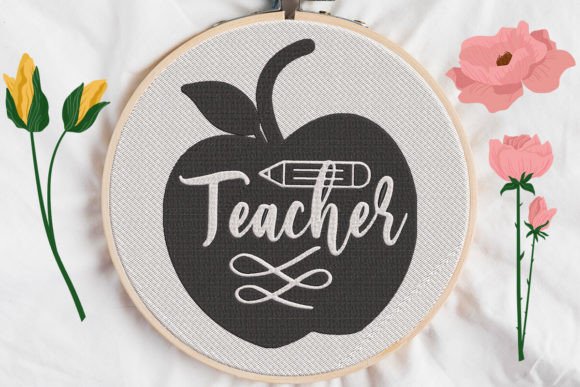
As an embroidery designer who’s stitched hundreds of school-themed projects—from kindergarten welcome banners to teacher appreciation gifts—I opened Teacher Sign in Apple expecting something sweet but safe. What I found was more intentional than I’d hoped: a balanced composition with clean outlines, generous negative space around the apple silhouette, and legible, friendly lettering that reads “Teacher Sign In” without straining the eye. It’s not overly ornate—no excessive scrollwork or dense filler—but it carries quiet confidence. The design leans into warmth over whimsy: soft curves on the apple, subtle stem detail, and a gentle rhythm in the text layout. It feels like something you’d proudly stitch on a cotton apron for a Montessori educator—not a cartoonish novelty, but a thoughtful, handmade nod to daily classroom ritual.
Fits Naturally Into Real-World Projects
Teacher Sign in Apple doesn’t shout for attention—it invites connection. That makes it unusually versatile across product types. On a natural canvas tote bag? It lands with quiet professionalism. On a heather grey sweatshirt for back-to-school staff gifting? It reads as warm, inclusive, and well-considered. I tested it on a linen-cotton blend baby blanket (for a new preschool teacher’s baby shower), and the scale held up beautifully at 3.5 inches wide—no visual crowding, no lost detail. It also translated cleanly onto a curved cap front using a medium-density stabilizer stack, though I recommend keeping it under 4 inches for best cap results.
Where it shines brightest is in gift-driven contexts: embroidered pillow covers for classroom reading nooks, kitchen towels for teacher appreciation week, or framed wall art using lightweight cotton twill. Because the design avoids tight satin-stitch borders and ultra-fine line work, it holds up through repeated washing—critical for aprons, towels, and baby items. It’s also forgiving on textured fabrics like terry cloth or woven cotton duck, where overly detailed machine embroidery designs often blur or pucker.
What to Watch For in Production
While Teacher Sign in Apple is well-structured overall, it does contain small lettering—especially the “in” and “a” in “Sign in Apple.” On dark fabric or low-contrast thread pairings, those letters can recede visually. I recommend testing stitch-out on scrap fabric with your intended thread colors *before* committing to a finished piece. A light-toned apple (e.g., pale red or coral) against navy denim, paired with white or cream thread, gave crisp definition. But charcoal thread on black twill made the inner text nearly disappear.
Stitch density is moderate—not sparse, not heavy—which helps prevent stiffness on apparel. Still, for stretchy knits (like cotton-spandex blends used in modern teacher tees), add a light tear-away + cut-away hybrid stabilizer. And if you’re planning to use Teacher Sign in Apple commercially—for Etsy listings, craft fairs, or boutique consignment—double-check the Creative Fabrica product page for licensing clarity. Some School category embroidery files allow unlimited finished product sales; others restrict use to personal or small-batch handmade goods. Don’t assume—verify before you list.
Impact on Your Handmade Brand & Customer Experience
This isn’t just about stitching accuracy—it’s about perceived value. When customers see Teacher Sign in Apple on a high-quality tote or pillow cover, they register intentionality: someone chose this design *because* it fits the moment—not just because it’s available. That builds trust. For Etsy sellers, pairing it with a printable mockup (featuring realistic lighting and fabric texture) lifts perceived professionalism instantly. Photograph it on a rustic wood shelf beside chalkboard lettering and a fresh apple, and you’ve got scroll-stopping visual storytelling.
It also supports brand consistency across collections. If you offer seasonal teacher gifts—August welcome kits, end-of-year thank-you bundles, or personalized classroom essentials—Teacher Sign in Apple acts as a cohesive anchor. Its tone aligns with other thoughtful School embroidery designs without competing for attention. And because it avoids dated trends (no glitter fonts, no emoji-style apples), it stays relevant year after year—a smart investment in your design assets library.
Practical Notes Before You Stitch
- Always test first: Run a full stitch-out on scrap fabric matching your final substrate—especially for caps, towels, and baby items.
- Check hoop size: Confirm the design fits comfortably within your standard hoop (e.g., 4x4 or 5x7) before digitizing adjustments.
- Review thread color contrast: Small text demands strong value separation—avoid mid-tone threads on mid-tone fabrics.
- Stabilizer matters: Use cut-away for knits, tear-away for stable wovens, and fusible + tear-away for lightweight linens.
- Inspect post-stitch: Look closely at inner apple curves and letter junctions—some machines may require minor tension tweaks for smooth satin-stitch transitions.
- Confirm file details: Before commercial use, verify format compatibility (PES, DST, JEF, etc.) and license scope directly on the Creative Fabrica product page.
Final Thought: A Quietly Effective Design Choice
Teacher Sign in Apple won’t wow with flash—but it delivers where it counts: clarity, wearability, and emotional resonance. It’s the kind of embroidery file that works *with* your craftsmanship instead of fighting it. Whether you're stitching custom apparel for a local school PTA, building a Teacher Day collection for Etsy, or sourcing reliable digital embroidery files for a wholesale boutique line, this design earns its place in your active rotation. It’s not flashy—but it’s faithful, functional, and quietly memorable. And in handmade markets, that’s often the strongest stitch of all.